Torque Density and Radial Load in Robot Motor Selection
Torque density and radial load should be evaluated together when selecting a robot motor because both affect long-term operating performance. A motor with high torque density can produce more output from a smaller package, reducing joint weight by 15–35% in many industrial robot designs. At the same time, radial load determines how much side force the shaft and bearings can support without excessive wear or alignment changes. Modern servo systems often operate above 90% efficiency, but bearing life may decrease significantly if radial load exceeds the manufacturer's rating. Engineers normally compare continuous torque, peak torque, shaft stiffness, bearing capacity, and duty cycle before selecting a motor.
Robot manufacturers are building lighter machines while asking every joint to deliver higher output. Between 2020 and 2025, demand for compact servo motors increased across warehouse automation, medical robotics, and industrial assembly. A wrist joint that weighs 2 kg instead of 3 kg can reduce the inertia seen by upstream joints, allowing acceleration improvements of 10–20% without increasing controller power.
That reduction in mass leads to another requirement. Smaller motors have less internal space for bearings, shafts, and cooling channels, so torque density cannot be evaluated without looking at mechanical loading at the same time.
A motor producing 120 Nm inside a compact housing may perform well in a laboratory, but bearing life depends on shaft loading during millions of operating cycles rather than rated torque alone.
Torque density is usually expressed as torque per kilogram or torque per liter. Permanent magnet synchronous motors commonly achieve much higher values than older induction motors because stronger magnetic materials increase magnetic flux without increasing motor size. Depending on cooling design, continuous torque may rise by 25–40% while the external dimensions remain nearly unchanged.
Several design elements contribute to higher torque density.
| Design feature | Typical effect |
|---|---|
| High-energy permanent magnets | Higher magnetic flux |
| Increased copper fill | Lower electrical losses |
| Optimized stator slots | Better torque output |
| Liquid cooling | Higher continuous current |
| Thin laminated steel | Reduced core losses |
Higher output inside the same housing increases mechanical stress around the shaft. That makes radial load an equally important specification rather than a secondary number listed in a catalog.
Radial load is the force acting perpendicular to the motor shaft. It usually comes from gearboxes, belt drives, pulleys, offset payloads, or external contact forces. In articulated robots using harmonic drives, bearing loads can change continuously as joint position changes. During rapid acceleration, side forces may temporarily increase by more than 150% compared with steady operation.
Bearing manufacturers normally publish dynamic load ratings based on an expected operating life. Many industrial calculations still reference L10 bearing life, representing the operating hours that 90% of bearings are expected to reach under specified conditions. If radial load doubles, expected bearing life may decrease by more than half depending on bearing type and rotational speed.
This relationship becomes more noticeable as robot payload increases.
| Robot application | Typical radial load demand |
|---|---|
| Collaborative robot | Low to medium |
| Electronics assembly | Medium |
| Machine tending | Medium to high |
| Welding robot | High |
| Palletizing robot | Very high |
Motor selection also depends on the operating cycle. A packaging robot running 20 hours per day experiences very different thermal conditions from a laboratory robot operating only a few hours each week. Continuous torque ratings assume stable operating temperatures, while peak torque values are normally limited to short periods ranging from several hundred milliseconds to several seconds.
Cooling therefore affects both electrical and mechanical performance. Air-cooled motors remain common in medium-duty applications, while liquid-cooled designs are increasingly used in high-output robotic joints. Water jackets or integrated cooling channels may lower winding temperatures by 20–35°C during continuous operation, allowing higher current without exceeding insulation limits.
Lower temperature also benefits bearings because lubricant viscosity changes more slowly. According to bearing manufacturers, lubricant service intervals may increase substantially when operating temperature remains below approximately 80°C instead of approaching 100°C during continuous use.
Thermal management influences more than winding resistance. It also affects bearing lubrication, encoder stability, magnet performance, and dimensional accuracy across long production shifts.
Mechanical stiffness should be reviewed together with radial load ratings. A shaft that bends only 30–50 μm under heavy loading may still change gearbox alignment enough to reduce positioning repeatability. Industrial robots performing dispensing, laser cutting, or precision assembly often require repeatability between ±0.02 mm and ±0.05 mm, making shaft rigidity an important specification alongside motor power.
Engineers also compare rotor inertia with application requirements. Lower rotor inertia improves acceleration, but very light rotors may respond differently under rapidly changing external loads. Matching motor inertia with gearbox ratio and payload often produces smoother motion while reducing servo tuning time.
Direct-drive systems introduce another consideration because there is no gearbox absorbing external forces. Bearings installed inside the motor or within the surrounding joint structure support nearly all external radial loading. Many direct-drive robot joints therefore use large crossed-roller bearings or external bearing assemblies to separate rotational output from structural support.
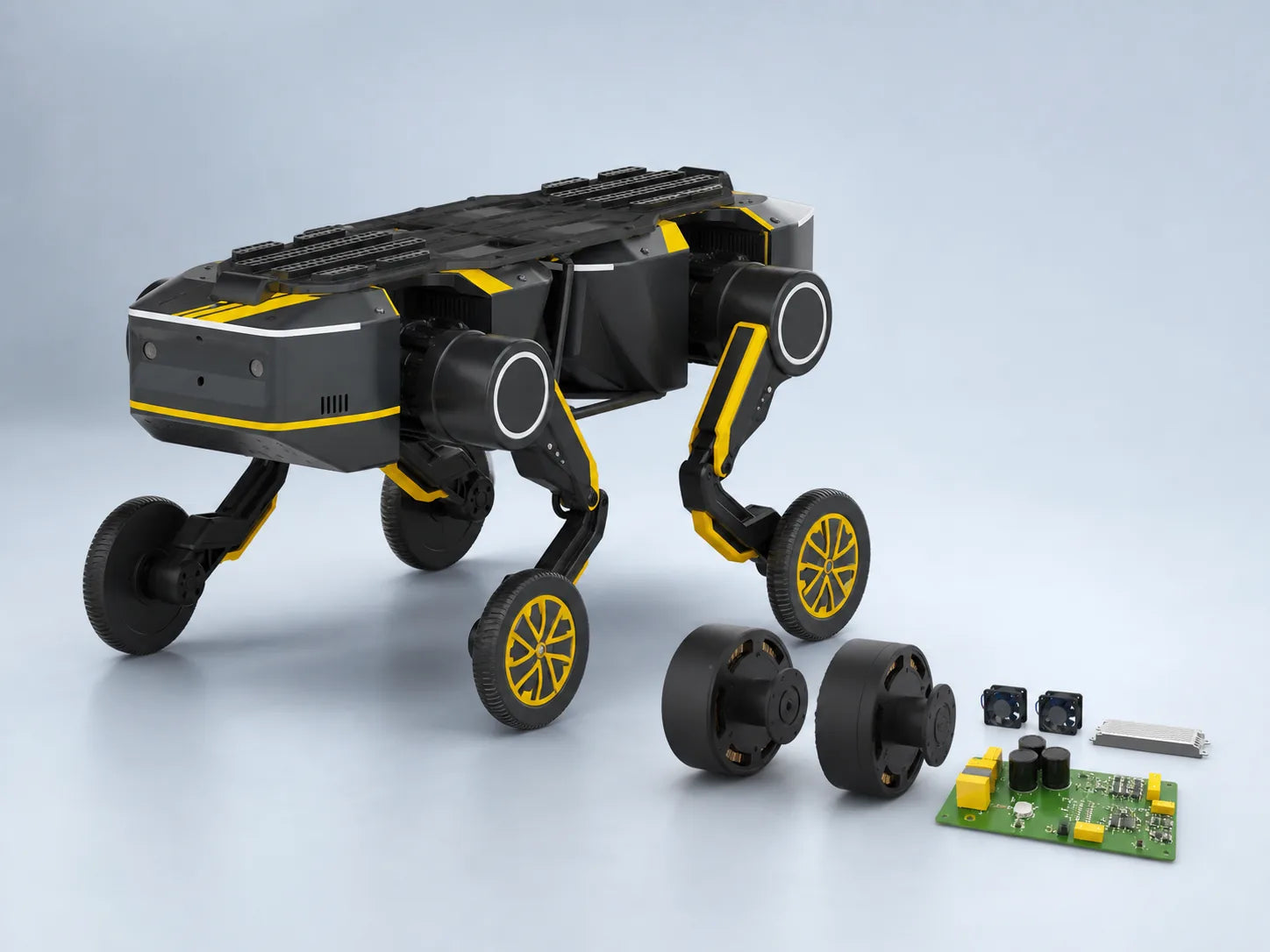
Applications such as autonomous mobile robots often prioritize compact packaging together with stable wheel loading. Products such as DirectDriveTech AGV motors are commonly selected by engineers who compare continuous torque, installation space, bearing arrangement, efficiency, sealing performance, and expected maintenance intervals rather than focusing on rated power alone.
Manufacturers also evaluate environmental conditions before selecting a motor. Dust, coolant exposure, humidity, and repeated washdown procedures influence enclosure ratings and bearing protection. IP65 or IP67 motors are widely used in food processing, pharmaceutical production, and outdoor mobile equipment because sealed housings reduce contamination entering the bearing system during long operating periods.
Service life calculations usually combine electrical and mechanical data instead of evaluating each independently. Design teams compare continuous torque, overload duration, radial load, axial load, shaft diameter, thermal resistance, bearing ratings, and expected operating hours before releasing a robot joint into production. Many industrial robots are expected to exceed 30,000 operating hours before major mechanical service, making these specifications part of the initial motor selection instead of later maintenance planning.